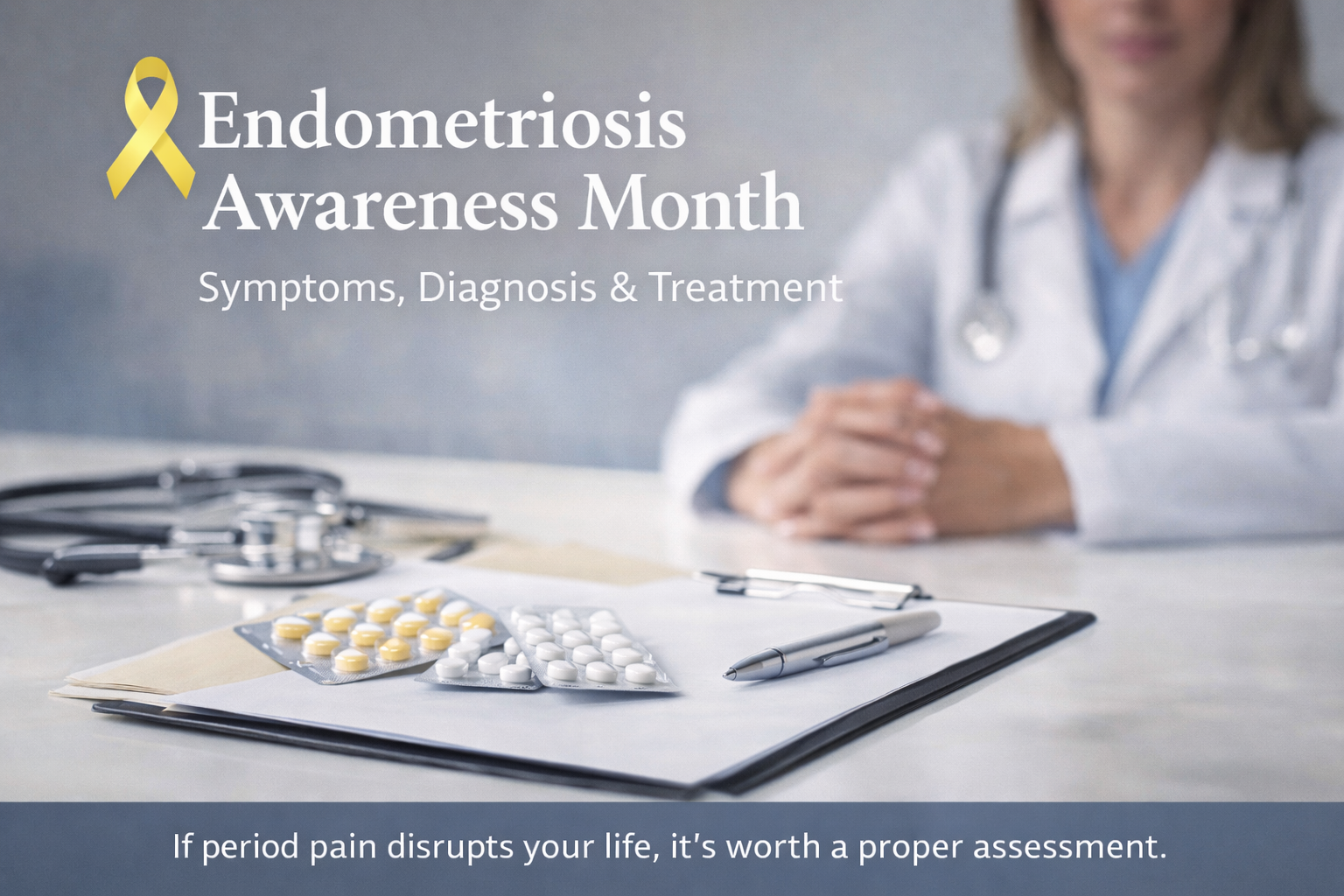
March is Endometriosis Awareness Month, a good reminder that “bad period pain” shouldn’t be dismissed as normal. Endometriosis is common, it can be life-altering, and it’s still often under-recognised. Endometriosis UK estimates it affects 1 in 10 women and those assigned female at birth in the UK (around 1.5 million people).
If you’re dealing with pain that affects work, travel, relationships, or your energy levels, especially if it comes in cycles, this article explains what to look for, how diagnosis typically works in the UK, and what treatment options may help. It’s written for women who want clear, practical guidance and a sensible next step: booking an appointment for a proper assessment.
What is endometriosis?
Endometriosis is a condition where tissue similar to the lining of the womb (endometrium) is found outside the womb. It can cause inflammation, scarring, and pain, often linked to the menstrual cycle.
The NHS describes endometriosis as a condition that can cause symptoms like pelvic pain and painful periods, and explains that there isn’t a cure, but symptoms can be managed with treatment.
Common symptoms (and the “red flags” many women ignore)
Symptoms vary, and you don’t have to have all of them. Some people have endometriosis with mild symptoms; others have severe symptoms.
Common symptoms include:
-
Painful periods that stop you from normal activities
-
Pelvic pain (sometimes outside of periods too)
-
Pain during or after sex
-
Pain when opening your bowels or passing urine (often worse around periods)
-
Heavy or long periods
-
Bloating (“endo belly”)
-
Difficulty getting pregnant / subfertility
These symptoms (including pelvic/lower back/leg pain, painful periods affecting daily life, pain during sex, and bowel/bladder symptoms) are also reflected in NHS Scotland patient guidance.
When to take symptoms seriously
Consider booking a women’s health appointment if:
-
You regularly need strong pain relief just to function
-
Your pain is worsening over time
-
You’re missing work or cancelling plans because of your cycle
-
You have bowel/bladder symptoms around your period
-
You’re trying to conceive and it’s taking longer than expected
Example: You plan client meetings around your period because you’re never sure if you’ll be able to sit through a long meeting without pain. That’s a signal to get assessed, not something you should have to “push through”.
Endometriosis vs other causes of pelvic pain
Endometriosis can overlap with other conditions, which is one reason diagnosis can take time.
Other possibilities include:
-
Adenomyosis
-
Fibroids
-
Pelvic inflammatory disease
-
Irritable bowel syndrome (IBS)
-
Bladder pain syndrome/interstitial cystitis
A GP assessment is about spotting patterns, ruling out red flags, and choosing the right investigations and referrals.
How endometriosis is diagnosed in the UK
NICE guidance covers diagnosis and management and aims to raise awareness of symptoms, advise on referral, and outline treatment options.
Diagnosis may include:
-
A detailed symptom history (including timing across the cycle)
-
Examination where appropriate
-
Blood tests if needed to rule out other causes (depending on symptoms)
-
Ultrasound (useful for some findings, but a normal scan does not always exclude endometriosis)
-
Referral to gynaecology when symptoms are persistent, severe, or not responding to initial treatment approaches
-
Laparoscopy (keyhole surgery) can be used to diagnose and treat endometriosis in some cases, including removal/ablation of endometriosis and scar tissue.
A newer option: a non-invasive saliva test (Endotest®)
In some settings, a newer diagnostic option, Endotest®, may be available. It’s a non-invasive, saliva-based test developed by the French biotechnology company Ziwig. The test analyses micro-RNAs (miRNAs) in saliva using next-generation sequencing (NGS) and AI-driven pattern analysis, looking for a biomarker profile associated with endometriosis.
How accurate is it?
Published research on the underlying saliva miRNA signature has reported high diagnostic accuracy. For example, one prospective study reported a sensitivity of 96.7% and a specificity of 100% for the saliva-based miRNA signature used to detect endometriosis.
(As with any test, accuracy figures can vary by study design and patient group, so results still need to be interpreted in the context of symptoms and clinical assessment.)
What it can and can’t do
-
May help shorten the diagnostic pathway for some women, particularly where symptoms are strongly suggestive but standard tests haven’t provided clarity.
-
It’s not a replacement for a proper clinical review. A negative result doesn’t automatically rule out endometriosis, and a positive result still needs to be considered alongside your history, examination, and appropriate onward referral.
Access and suitability
Endotest® is described as a prescription-only in vitro diagnostic medical device and is intended for symptomatic patients aged 18–43 in its CE-marked indication.
Availability and pathways can vary, but it is offered in some private diagnostic settings (for example, via laboratory providers).
If you’d like to explore whether it’s appropriate for you, the most sensible first step is a women’s health appointment to review your symptoms, rule out other causes, and decide what investigations or referrals are most appropriate.
A quick note on waiting times
NICE has highlighted the need for earlier detection and acknowledges capacity pressures in services.
If you’re stuck in limbo or need clarity sooner, a private GP appointment can be a useful step for assessment, planning, and referrals.
Treatment options: what can actually help?
There’s no one-size-fits-all plan. Treatment depends on your symptoms, whether fertility is a priority, and how the condition is affecting your life.
Pain relief
The NHS lists painkillers such as paracetamol and ibuprofen as part of symptom management.
A clinician can also advise on safe dosing, combinations, and what to do when standard options aren’t enough.
Hormonal treatments
Hormonal treatments can reduce pain by suppressing the cycle and are often first-line when pregnancy isn’t an immediate goal. The NHS notes hormones (such as the combined pill or other hormonal medicines) may help ease pain, and that hormones aren’t used if you’re trying to get pregnant.
Surgery (when appropriate)
Some patients benefit from surgery—often via laparoscopy—to diagnose and treat endometriosis, including removing lesions and scar tissue.
This is typically considered when symptoms are severe, persistent, or not responding to other treatments, and should be guided by specialist care pathways.
Fertility support and referral
Endometriosis can be associated with fertility challenges, and NICE guidance specifically covers management where fertility is a priority.
At Dr Wayne Cottrell & Co, we offer women’s health appointments and can support with blood tests and onward referral for fertility assessment where needed.
5) Newer options (for selected patients)
In England, NICE has issued technology appraisal guidance recommending relugolix–estradiol–norethisterone (Ryeqo) as an option for treating endometriosis symptoms in adults of reproductive age who have had medical or surgical treatment for endometriosis.
This won’t be suitable for everyone, but it’s a meaningful development to discuss with a specialist if you meet criteria.
What we can do in a women’s health appointment (Canary Wharf)
If you book a women’s health appointment at Dr Wayne Cottrell & Co, the goal is to move from “I think something’s wrong” to a clear plan.
We can help with:
-
A structured symptom review (including cycle tracking)
-
Examination where appropriate
-
Discussing appropriate pain and hormonal options
-
Referral pathways (e.g., imaging and specialist gynaecology/endometriosis services)
-
Fertility planning and related blood tests/referral where needed
Practical next steps you can take this month
If you suspect endometriosis, here’s a simple action list:
-
Track your symptoms for 2–3 cycles (pain level, timing, bleeding, bowel/bladder symptoms, fatigue)
-
Note any “life impact” (missed work, sleep disruption, cancelled plans)
-
Write down what you’ve tried (pain relief, pill, heat, etc.) and what helped
-
Book a consultation to discuss diagnosis and next steps
FAQs
Is endometriosis “just bad period pain”?
No. Period pain that disrupts life, worsens over time, or comes with bowel/bladder symptoms deserves assessment.
How is endometriosis confirmed?
Diagnosis may involve history, examination, imaging, and sometimes laparoscopy (keyhole surgery), which can also treat endometriosis at the same time.
Is there a cure?
There’s currently no cure, but treatments can help ease symptoms.
If you’re experiencing painful periods, pelvic pain, or symptoms that are affecting your work and quality of life, don’t wait for it to “settle”. Book a Women’s Health appointment at our Canary Wharf clinic and we’ll help you create a clear plan for investigations, symptom control, and referral where appropriate.