
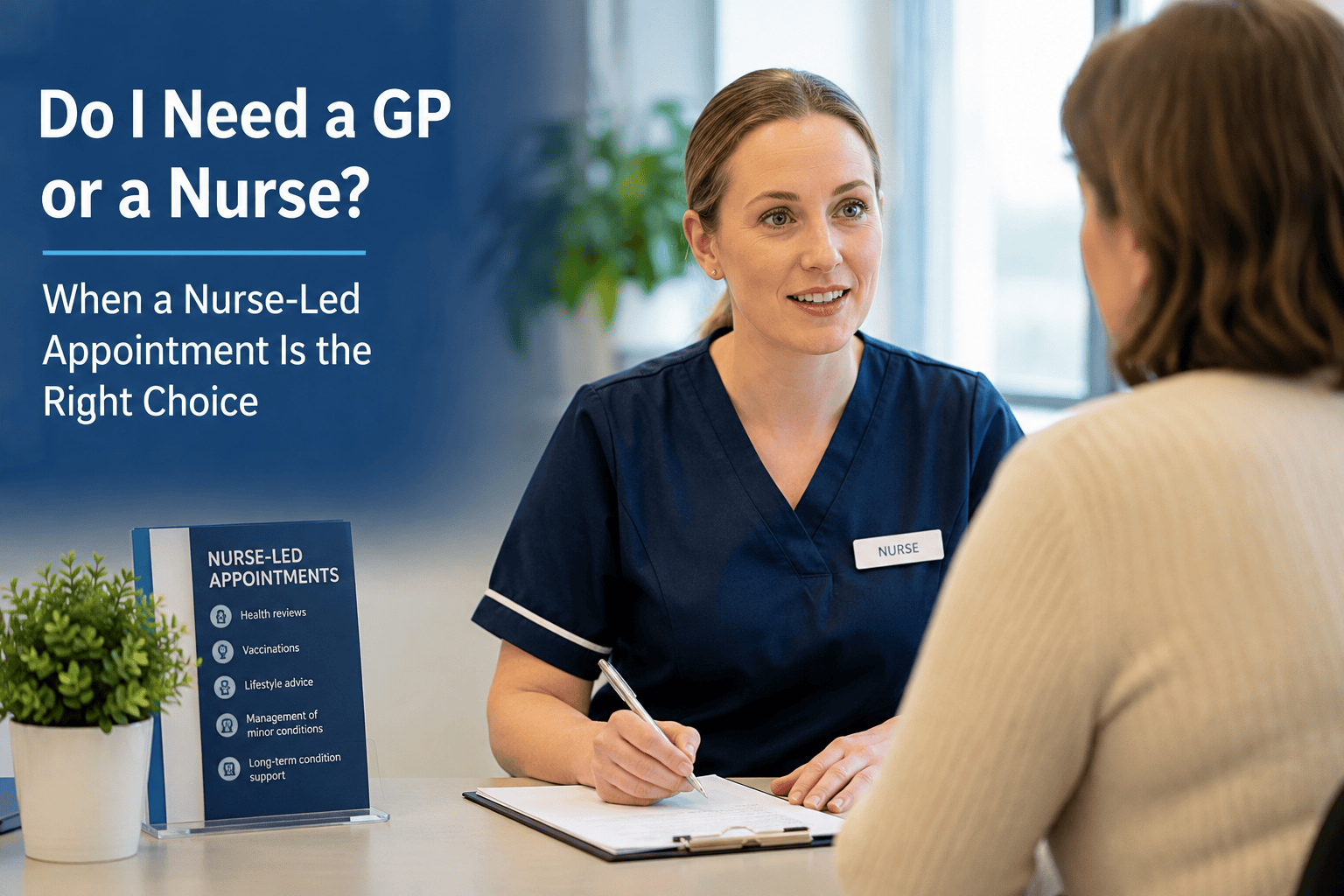
When you need a medical appointment, it is natural to assume that you should always book with a GP. In reality, many everyday healthcare needs can be managed safely and effectively by an experienced practice nurse or advanced nurse practitioner.
Choosing the right healthcare professional can make your appointment more efficient and ensure you see someone with the most relevant skills for the problem you want help with.
So, do you need a GP or a nurse-led appointment? The answer depends on what you need assessed or treated.
What can a practice nurse help with?
Practice nurses are registered healthcare professionals who work as part of the wider primary-care team. Their role can include preventive healthcare, vaccinations, wound management, screening, blood tests and monitoring of long-term health conditions.
NHS England describes general practice nurses as an important part of primary care, helping to deliver day-to-day healthcare alongside GPs and other clinical professionals. Their exact responsibilities vary according to their qualifications, experience and the services offered by the individual practice.
For many patients, a nurse-led appointment may therefore be the most appropriate choice.
When should I book a nurse appointment?
There are several situations where you may not need to see a GP at all.
Blood tests
A nurse-led appointment is often suitable when you have already been advised that you require a blood test or when the clinic provides blood-testing and health-screening services.
Blood tests can be used for many reasons, including checking cholesterol, blood sugar, iron levels, vitamin deficiencies, liver or kidney function and monitoring certain existing conditions.
Depending on the reason for testing, you may need a GP or another clinician to interpret the results and decide whether further investigation or treatment is required.
Vaccinations
Vaccination is a major part of practice nursing.
Nurses commonly administer routine and travel vaccinations, childhood immunisations and adult boosters. The UK Health Security Agency’s Green Book sets out UK vaccine recommendations and clinical procedures, providing national guidance for healthcare professionals administering vaccines.
A nurse appointment may therefore be appropriate for childhood vaccinations, travel vaccines, seasonal immunisation or a vaccination programme that has already been agreed.
If your vaccine needs are more complicated, for example, because of an existing medical condition, previous vaccine reaction or an unusual international vaccination history, additional clinical assessment may be needed first.
Wound care and dressing changes
Practice nurses are also experienced in wound assessment and management.
This may include changing dressings, checking how a wound is healing, caring for some post-operative wounds and removing stitches or staples when appropriate. NHS treatment-room services routinely include wound assessment, dressings and suture removal.
A nurse can also identify signs that a wound may need further medical assessment.
If a wound becomes increasingly painful, hot, swollen or red, produces pus, or you develop a fever or feel generally unwell, you should seek medical advice promptly as these may indicate infection.
Can a nurse check my blood pressure, weight or general health?
Yes.
Nurse-led appointments are commonly used for routine observations such as:
- Blood pressure checks
- Weight and BMI measurements
- Health-promotion advice
- Long-term condition monitoring
- Selected screening appointments
These checks can be particularly useful when monitoring cardiovascular risk, medication or an existing condition.
General practice nurses also play an important role in preventive healthcare, helping patients identify risks and manage their health before problems become more serious.
What is an advanced nurse practitioner?
An advanced nurse practitioner, often shortened to ANP, has additional clinical training and can manage a wider range of medical problems.
Depending on their qualifications and role, an advanced nurse practitioner may be able to take a medical history, examine a patient, diagnose common conditions, arrange investigations, prescribe medicines and refer patients for specialist assessment.
This means that for some minor illnesses and injuries, an advanced nurse practitioner can offer much of the same initial assessment that a patient might traditionally expect from a GP appointment.
However, nurse roles vary between practices. Reception or clinical staff can advise whether a nurse is the right person for your particular concern.
When should I see a GP instead?
A GP appointment is generally more appropriate when you have a new or unexplained medical problem that may require diagnosis, particularly if the symptoms are complex or involve several different health concerns.
Examples might include:
- Persistent or unexplained symptoms
- New lumps or unexplained weight loss
- Ongoing abdominal or chest symptoms
- Complicated medication issues
- Symptoms affecting several parts of the body
- Concerns that may require specialist referral
- Multiple long-term conditions requiring review
- A problem that has not improved despite previous treatment
A GP may also be more suitable when your symptoms require a broader medical assessment or when the diagnosis is uncertain.
If a nurse assesses you and decides that a GP review is necessary, they can advise accordingly. Good primary care is based on teamwork rather than expecting patients to work out the exact diagnosis before they book.
What about minor illnesses?
This depends on the type of nurse you are seeing.
An advanced nurse practitioner may be able to assess and treat a wide variety of common illnesses, including some respiratory infections, minor injuries and other everyday health concerns. NHS primary-care services describe ANPs as professionals who can assess symptoms, diagnose conditions and arrange treatment or further investigation where appropriate.
A general practice nurse may have a different remit, focusing more heavily on vaccinations, wound care, screening and long-term condition management.
If you are unsure, tell the reception team briefly what you need help with. You should not need to disclose unnecessary personal details, but enough information to direct you to the right clinician can help avoid an unsuitable appointment.
Can a nurse help manage long-term conditions?
Often, yes.
General practice nurses frequently support patients with ongoing conditions such as asthma, diabetes and high blood pressure. This can include monitoring symptoms, checking measurements, reviewing agreed care plans and providing health education.
Advanced nurse practitioners may have an even broader role in managing long-term health conditions, depending on their area of expertise.
Regular nurse-led reviews can help patients keep track of their condition and identify when a GP or specialist review is needed.
Why choose a nurse-led appointment?
The biggest advantage is that you are seeing the healthcare professional whose skills best match the task.
A GP does not necessarily need to carry out every blood test, vaccination, dressing change or routine health check.
Nurse-led care can provide:
- Direct access to an appropriately trained clinician
- Focused appointments for specific procedures
- Continuity for regular monitoring
- Preventive health advice
- Convenient access to vaccinations and screening
- Referral to a GP when a more detailed medical assessment is needed
Evidence reviewed by NICE has also found that nurse-led care can produce health outcomes comparable with doctor-led care across a broad range of primary-care situations when delivered within the appropriate scope of practice.
What if I book the wrong type of appointment?
Do not worry.
You are not expected to know whether every symptom requires a doctor, nurse, pharmacist or another healthcare professional.
The important thing is to explain the reason for your appointment when booking. The practice can then advise which member of the clinical team is likely to be most appropriate.
If a nurse identifies something requiring a doctor’s assessment, they can recommend escalation. Equally, if you book a GP for something that could be managed more efficiently by a nurse, the practice may suggest a nurse-led appointment instead.
Nurse-led appointments in Canary Wharf
At Dr Wayne Cottrell & Co, our nurse-led services form an important part of the wider private GP service in Canary Wharf.
Patients may be able to book nurse appointments for services such as blood tests, vaccinations, wound care, injections, routine monitoring and selected health checks, depending on their individual needs.
For patients who are not sure whether they need a GP or nurse appointment, our team can help guide you towards the most appropriate clinician.
The aim is simple: the right appointment, with the right healthcare professional, for the right reason.
If you need a routine procedure, vaccination, blood test or nurse-led health check, speak to the team about whether a nurse appointment may be suitable.