
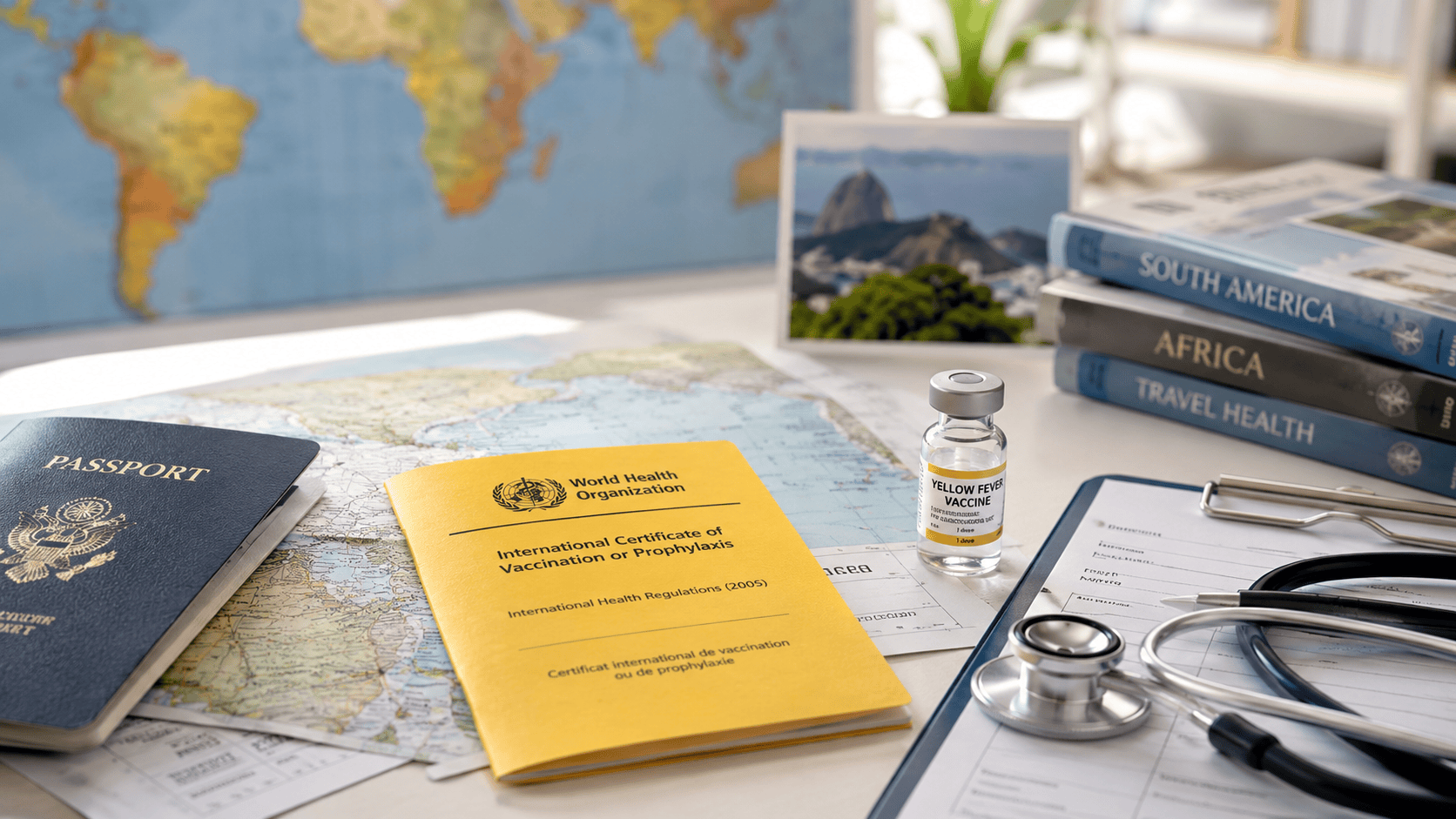
Yellow fever vaccination can be one of the more confusing parts of planning an international trip.
Some travellers need the vaccine because they are visiting an area where yellow fever is present. Others may need proof of vaccination simply to enter a country, even when yellow fever itself is not normally found there.
The rules can also change depending on where you have travelled immediately beforehand, how long you spent in transit and even which airport you connected through.
For UK travellers, the important distinction is this:
A yellow fever vaccination may be recommended for your health, required for entry, or both.
What is yellow fever?
Yellow fever is a potentially serious viral infection spread by infected mosquitoes. It occurs in parts of tropical Africa and Central and South America.
Vaccination is an effective way to prevent the disease. The World Health Organisation states that a single dose provides long-lasting protection for most people and that, under international rules, a valid yellow fever vaccination certificate can remain valid for life.
Mosquito-bite prevention is still important after vaccination, particularly because mosquitoes in yellow-fever regions may also transmit illnesses such as dengue and malaria.
Which countries require yellow fever vaccination?
There is no simple permanent list because entry requirements can change.
Broadly, there are three situations travellers may encounter.
Some countries recommend yellow fever vaccination because the disease occurs within the destination itself.
Some countries require proof of vaccination from ALL eligible arriving travellers.
Others only require a certificate if you have recently been in, or travelled through, a country considered to have a risk of yellow fever transmission.
This is why simply searching “Does my destination have yellow fever?” is not enough.
Your entire journey needs to be considered.
Which parts of the world have yellow fever risk?
Yellow fever transmission occurs primarily in parts of:
- West, Central and East Africa
- Central America
- South America
Countries with recognised risk include destinations such as Brazil, Colombia, Ghana, Kenya and parts of several other African and South American countries.
However, risk may exist only in particular regions within a country. A traveller spending time in one area may therefore receive different advice from somebody visiting another part of the same country.
Yellow fever cases are continuously being reported in 2026. These include cases in Africa and South America, which is another reason to check current advice!
Do I need a yellow fever certificate even if my destination has no yellow fever?
Yes — and this is where many travellers are caught out.
Some countries with little or no local yellow fever risk still require an International Certificate of Vaccination or Prophylaxis, often called an ICVP, if you arrive from a yellow-fever-risk country.
The aim is to reduce the possibility of an infected traveller introducing the virus into an area where mosquitoes capable of spreading it may be present.
For example, a traveller flying directly from London may face different entry requirements from someone arriving at the same destination after travelling through parts of Africa or South America.
This means your previous destination can sometimes matter just as much as your final destination.
Do airport stopovers count?
Potentially, yes.
Some countries apply their yellow fever certificate requirement to travellers who have transited through a yellow-fever-risk country.
The exact rules vary. Some specifically consider airport transits lasting more than 12 hours, while others may apply different criteria.
Imagine flying:
London → Nairobi → onward destination
Even if you do not plan to leave the airport, the length of the connection could affect the certificate requirements at your final destination.
This is why a travel-health consultation should consider every country on the itinerary, including connections.
What is a yellow fever vaccination certificate?
When yellow fever vaccination is given at an authorised centre, eligible travellers receive an International Certificate of Vaccination or Prophylaxis.
This is an internationally recognised document confirming that the vaccination has been administered.
You may need to present it at immigration or border control.
Yellow fever vaccination and the corresponding certificate can only be issued through a registered Yellow Fever Vaccination Centre in the UK.
How long before travelling should I have the yellow fever vaccine?
For someone receiving their first yellow fever vaccination, the international certificate becomes valid 10 days after vaccination.
So if your destination requires the certificate, getting vaccinated the day before you fly will not normally solve the problem.
Ideally, arrange your travel-health consultation several weeks before departure. This also allows time to consider any other recommended vaccines, malaria prevention and your medical history.
If your departure is closer, it is still worth seeking professional advice.
How long does a yellow fever certificate last?
For most travellers, a valid yellow fever certificate now lasts for life.
Previously, certificates were commonly considered valid for 10 years, but international rules were changed so that certificates issued following a valid vaccination remain valid for the lifetime of the person vaccinated. This also applies to older valid certificates that may still show an expiry date.
In most circumstances, you therefore do not need another vaccination simply because 10 years have passed.
Do I need a yellow fever booster?
Usually, no.
The WHO considers one dose sufficient for lifelong protection for most people, and international entry rules cannot routinely require a booster simply because more than 10 years have passed.
There can be individual medical circumstances where further advice is appropriate, so previous vaccination history should still be discussed with the clinician.
Who should not have the yellow fever vaccine?
Yellow fever is a live vaccine, so it is not suitable for everyone.
Additional assessment may be needed for people who:
- Have significant immune-system problems
- Take certain immunosuppressive medicines
- Have a severe allergy to vaccine components
- You are pregnant
- You are very young
- You are older and have certain health considerations
The WHO advises that the vaccine is generally not recommended for infants under nine months and that particular caution is needed in several other groups.
For some travellers who cannot safely be vaccinated, a clinician may consider whether a medical exemption is appropriate. Acceptance of an exemption remains subject to the entry rules of the destination country.
Do I need yellow fever vaccination for Thailand?
Thailand itself does not have a yellow fever transmission risk.
However, a certificate may be required if you arrive from, or have travelled through, a country where yellow fever is considered a risk.
So a traveller flying directly from the UK may have different requirements from somebody arriving in Thailand after travelling through parts of Africa or South America.
The same principle applies to many popular international destinations.
How do I know whether I need a certificate?
Before travelling, check:
- Your final destination
- Every country visited beforehand
- Airport connection countries
- The duration of your airport transits
- Your age
- Your previous yellow fever vaccination history
- The latest country-specific entry requirements
TravelHealthPro publishes country-specific information for UK travellers, while WHO maintains international certificate requirements. These requirements can change, so it’s sensible to check shortly before travel, even if you have visited the destination before.
Yellow Fever Vaccination Centre in London
Dr Wayne Cottrell & Co is a designated Yellow Fever Vaccination Centre in Canary Wharf, London.
Our travel-health team can review your complete itinerary, including stopovers and previous destinations, and advise whether yellow fever vaccination is recommended or whether a certificate is required for your journey.
Where vaccination is appropriate, we can provide the vaccine and International Certificate of Vaccination or Prophylaxis as part of your appointment.
We can also review the other vaccinations and travel-health precautions relevant to your destination.
If you are travelling to Africa, South America, or travelling through a yellow-fever-risk country on the way to another destination, arrange your travel-health appointment early enough to ensure any required certificate is valid before departure.
Where can I get travel vaccinations in London?
Dr Wayne Cottrell & Co provides personalised travel-health advice and adult and children’s vaccinations from its private clinic in Canada Place, Canary Wharf.
The team can review your Thailand itinerary, previous vaccinations, medical history and departure date before recommending suitable protection. The clinic also provides malaria-prevention guidance and is a designated Yellow Fever Vaccination Centre.
Book early where possible, but contact the clinic for advice even if you are planning last-minute travel.